General Tortoise Information
What Is A Group Of Tortoises Called?
A gathering of tortoises is often referred to as a herd but officially a group of tortoises is called a CREEP.
Do I need a license to keep an Aldabra Giant Tortoise?
If the tortoise is just your own personal pet then no, you do not need a license. If you are exhibiting it to the public in any way, then you need to apply for a performing animal license from your local council and you will then be subjected to inspections from the environmental health department to ensure that they are being kept in appropriate conditions. They can also come and inspect you while the animal is away from home. In our case, several times, during the year, when our tortoises are at a show, in different regions, the local officer will come along to check the license and procedures paperwork is up to date.
Aldabra tortoises are not covered by the Cites A10 paperwork but if you have imported them from the Seychelles region then you will need copies of import paperwork to prove that they arrived here legally.
Do Aldabra Tortoises Travel Well? How Do You Transport Them?
A small juvenile Aldabra can be popped into a box with some straw or other substrate to stop it sliding as you go around a corner, and then carried out to the car easily enough. You do not want them to get too warm before or during the journey or they will begin to fidget and try to climb out. It is best to put them somewhere darker or cover their crate over so they think it is night time but on the whole they do not mind travelling in a vehicle.
A larger juvenile animal would be more suited to being in the boot of the car where there would be more space, but keep them away from the exhaust side, you do not want them breathing in toxic fumes, you would not like it. We also highly recommend that you put a tarpaulin or something down to line the boot cavity first. It is an almost certainty that your tortoise will go to the toilet during the journey and you do no want it soaking into the carpet or the car will stink for ages.
Never mind the food treats and water for them, the first thing packed should be some rubbish bags, a roll or two of kitchen roll, some wet wipes and rubber gloves, if necessary, you will always need them.
If you are going to be regularly transporting the animal, then you may want to consider investing in an appropriately sized trailer, to put them in. Everything can be contained in one place and you wont need to deep clean your car afterwards! Our animals do like to travel with a friend but if you only have one Aldabra then you do no have that option. Pack some straw around them, in he trailer, and make them feel secure and comfortable so they are less likely to move around. You do not want an animal the size of Samson moving around back there, he can upset the balance of the vehicle by shifting his weight. So, make sure you load the trailer properly, put the weight over the axle and not behind it, pack out the trailer with extra hay bales or something if necessary, maybe even fit a slide barrier. Again ,it all helps to keep the centre of gravity in the right place and minimises the chance of causing an issue during travel.
You do not physically need to restrain the animal during transport but make sure the floor of the trailer is lined with something like rubber matting, so that the tortoise doses not slide back and forth when you break and accelerate. For one you are going to make them feel ill and stressed by this, plus you also risk damaging the wall sf the trailer.
We do recommend the walls of the trailer are lined so that the tortoise does not cause any damage to the metal skin. Also fit a layer of insulation behind the walls to keep it warmer. Ideally, get a trailer with a ramp on it so you do not have to physically lift the tortoise in and out. It is an investment for the future too, when the animal is too big to easily lift. If necessary you could make you own ramp out of wood, just do no make the angle too sharp or they wont want to use it.
Like with any animal it is always advisable to try getting it in and out of a trailer before you actually need them to use it. Allow them chance to familiarise themselves with something new but above all allow yourself plenty of time, on the day, to get them loaded and settles before you need to set off. It cuts down on stress levels for everyone!
It will depend on the time of year and the length of the journey as to whether you need to put heating in the trailer. If it is just a short trip, to something like to the local vets and back, they should be fine, you can always put bottles of warm water around them and cover with a duvet, if you are overly concerned. If you are going to be a lot longer or travelling further and the animal will be in the trailer overnight, then you will need a back up plan. If it is the height of summer they will probably be OK. You do not need a tortoise rampaging around your trailer in the middle of the night because it is too warm. However you could encounter an unexpected cold snap so we would recommend you invest in a leisure battery and a panel heater. That way you are all set up, to boost their temperature, if you need it, takes the worry out of the journey. A leisure battery will not be enough to run the panel heater to keep them hot all of the night, it will be able to keep them warm.
Its not just the cold you need to worry about though, if it is a hot day, make sure you stop regularly on a long journey just to get some fresh cooler air into the trailer and make sure your passenger is OK. A fibreglass roof is fine, it lets some natural light in and heat too, but putting a shelf in so they can hide in the dark and provide shade is a good idea. You do not want the tortoise to become over heated, or stressed and begin wandering around.
If you are going somewhere like the vets and you have never been to that practice before it is always advisable that you contact them to see if you can get your trailer on their car park. Some of these places can be tight on spaces, or have height restrictions. You do not want to have to park on the street and walk the animal in, you may miss your appointment! Also check if there are steps into the building, it is not usual but they would cause you issues and if you know in advance you can take something with you to help you overcome the problem. Some vets will find it easier to actually come outside for the consultation and look at the animal in situ.
It may be an idea to invest in something like a piano trolley so that the animal can be wheeled around easily, if going inside the building. These can be quite high off the ground though, so you will need to take manpower with you to load the animal onto it. When considering buying a trolley to move them, you need to remember one very important thing tortoises have legs, boxes do not! You need a trolley strong enough to take their heavy weight but if the tortoises feet can reach the floor they can just walk right off the trolley. You may need to put a board over the top for the tortoise to sit on, if that is an issue for you but do not make the board too wide or you wont get it through a doorway.
Your method of transport will come down to:
- How big are, and will they fit in your car boot.
- Are you strong enough to lift it into the boot.
- Do you have physical assistance to lift it into the boot at both ends of the journey, you cannot always rely on veterinary practice staff to be able to help with this. It may be best to ask first.
- Do you have access to a trailer. The capabilities of both yourself and your car, and the experience to tow one.
As some of you may know, during the summer months, several of our animals get taken out to places like County shows, where the public get chance to meet and interact with them. There are usually 8 of them involved in such an outing and more often than not they are the larger animals, so you can not tuck them in a box and carry them out to the car and be on your merry way in minutes. an outing like that needs a lot of planning, forethought, and suitable equipment.
Out of necessity we have a ramp on the back of the trailer and they are encouraged to walk up and down it to get in and out, rather then us trying to lift them into it. The smaller animals can be carried if necessary, especially as they occupy an upper level during transportation. However, the larger ones are too heavy, so they have to walk, it can be very time consuming, depending on how cooperative they are feeling. The amount of cooperation does tend greatly on the time of day you are endeavouring to carry this out.
If we are loading first thing in a morning, then you have to get up extra early to crank up their heating to warm them up quicker. Then you have to shuffle them around until you can get to the animal that you want. Inevitably it will be in the centre of the group and the most inaccessible.
From there the selected animals are loaded onto a steel transport cage and tractored to the back of the trailer and loaded inside by being encouraged to walk off the transport box and up the ramp. However, this loading takes numerous trips so if they are awake and it is already developing into a nice day, then the ones already loaded do not want to settle back down to sleep, they want to get up and go out and eat. This means that as you are trying to get one animal inside, one or more are trying to get back out. You can end up physically moving the same tortoise a dozen times or more.
To make life easier they are sometimes loaded the night before, if it will be an early start. This means they are actively looking for somewhere to settle down for the night and go to bed. So, once they get inside the trailer they are much less likely to want to come back out again, immediately. The trailer is heated for them, so we plug them in and they are comfortable and secure. Often they wont realise that they have done a road trip, they just get up and march out onto a grass plot when the doors are opened and are quite happy, it does not usually register that it is not their usual grass plot. They may even prefer it if they have lusher grass to eat.
At home 90% of them will put themselves back to bed in the evening, but when they are at a show they are not always sure where the back of the trailer is, as they display pen does not always face the same direction, so they need a little help steering them in the right way.
Some of the tortoises will walk for food, Big Bonnie loves a Banana but if they have had a good day munching grass, a treat will not always work, so having tried the carrot it is time for the stick.
Our tortoises are part of a training program, we have. To encourage them to walk with us to go to bed. To do this we use a Tickling Stick, aka an old broom handle. The idea is that if you tickle or tap the tortoise on the white lines on their shells, then it makes them move. These white rings are new growth rings and are a little more sensitive than the rest of the shell. Tickling them there is a bit like is being tickled on the shoulder blades, it makes you wriggle and squirm. So as they wriggle and move, you steer them where you want them to go by walking beside them. The more we do it the more they get the idea of what we are trying to achieve, and the more ready they are to cooperate. Usually it does not take much to get them moving, once they see the stick appear, and then they only require the occasional tap, when they have stopped to rest too long. It is quite a skill keeping a herd of Aldabra moving back to bed whilst several of them will inevitably try to make a bid for freedom and get a last bite of grass, they missed earlier.
However, if the tortoise does not want to go to bed they can be very stubborn and on occasion it has been quicker to move the trailer to the tortoise rather than the other way around!
This is the only time of the day that we use this method so they know that when feet arrive beside them and they feel a tapping on their shell they know that it is bed time, even though the sun is still shining, as shows often finish a lot earlier than they would normally go to bed, at home. This means that it can take a while to get them safely back aboard their trailer and unfortunately, until that happens we can not really dismantle the fencing of the stand or you would have tortoise running amok around the show ground. Their reluctance to stop basking in the evening sunshine is often why the Giant Tortoises are the last to leave a show ground, and we are still packing up by torchlight!
Why Do You Take Your Aldabra Tortoises To Various Shows In The UK?
There are several reasons why the tortoises attend shows.
- They are acting as ambassadors for their species, there are many visitors who come to different events who have never seen an Aldabra giant tortoise in real life, whether that is at somewhere like Devon County Show, a shopping centre in the middle of Bracknell or Cheshire steam festival. Not everyone has time, ability, money or the desire to travel thousands of miles to see them in the wild. However, the more people who know these majestic animals live on this planet, the more people will be inspired to do something towards helping protect the habitat of these walking dinosaurs. Aldabras have been inhabiting this planet long before humans appeared in the world, and they did not ask for man to ruin it and endanger them. Our tortoise are doing their bit to inspire people to help protect their wild brethren now and into the future. We are always happy to try answering any questions you may have about the tortoises. Many times it is something that someone else has asked before, so do not be afraid we will think it is stupid or something, we have all had to learn, we have been there too. And the more unusual questions are good for us as well, there is always something new to learn, and we do not know everything, so its interesting to research an answer if necessary. If you prefer you can drop us an email to ask a question to aldabragianttortoisesuk@gmail.com
- The tortoises also come out to meet the general public to raise funds for their upkeep. We are private individuals, not a zoo, and we do not get endorsements or major sponsorships to help with their upkeep. they are our family pets and it is our choice and responsibility to have them, so the expense is something we have to factor into our lives. Potential Aldabra owners also need to accept that they are not cheap animals to look after. That is a fact. All of the money they kindly receive from visitors coming to meet them or donations into the buckets is 100% used for their benefit, not ours. Whether that is for a bag of carrots as a treat. to help pay for their winter electricity bill or to buy something for their house, when they have broken it. or just something to improve and enrich their life in general, maybe even to contribute to a vets bill. We do not aim to spoil them, they might be our pets but it is not our intention to pamper them, they will get as close a representation to how their life would be in the wild, as we can make in the UK. All of the money we receive, large or small, goes towards their welfare, and for those cynical people out there, it is also declared to the tax man too!
- The third reason, and it is an important reason, is that they enjoy it. Many of the tortoises like the stimulation of meeting the public, under supervision. Admittedly not all of them are people tortoises and so they stay at home, chilling in the field with their friends, none are forced to go out if they do not want to. But for some of them they really like the stimulation of people fussing them and stroking them. If they did not like it then we would not entertain the idea of taking them out. They get in the trailer at home and get out to new fresh grass and they can do tortoise things, wandering around their pen and eating, in the sunshine, what is not to love for them? they are not there to perform but if someone is taking their photo, while they are busy eating, they are not really that bothered.
Do Aldabra Tortoises Have Personalities?
Yes, they are like people, some of them are happier to interact with people and other tortoises, whilst others prefer to keep to themselves more. A number of them will actively come for a tickle whereas others will flounce off in a huff. A couple of them can be very stubborn, particularly at bedtime, if it is a nice night and they are actively eating then they do not see why they need to stop, just to go back to the house, so it can take a while to get them all rounded up and safely inside, they are too big to just pick up.
They can be set in their ways, some of ours have certain areas of their pen that they like to graze or certain places in the house that they always try to claim at night. Our second biggest male Trojan is definitely a water baby, he adores to be submerged in the wallow on a hot day and even often on a not so hot day and then gets stubborn about coming back out again, so we have to drag on the waders and get in there with him to get him moving!
A number of them are very curious, they will take notice of your presence in their pen and come over to investigate, so you need to be alert to your surroundings. If you are hand feeding one of the animals, it is quite likely that more of them will soon arrive on the scene to see what is going on and you can soon find yourself swamped in Aldabra, all wanting a bit of Banana , or a carrot as a treat!
Are They Intelligent?
Aldabra Tortoises have a reasonably high intelligence rate and are often compared with a white rat. They can learn and remember things but are not the cleverest animals on the planet. Although, sometimes you would swear they do not have two brain cells to rub together, they can be complete idiots. However, they do not need to be, they have a very plain and boring lifestyle, they do not need to evade hunting animals or find and catch live prey, grass does not run away from them!. They have sufficient intelligence to do what they need to do but the actual brain of a tortoise is extremely small. Someone, who has written many books on tortoises, once compared them to having the intelligence of a doorknob, it is sufficient to get the job done but not to be anything else.
In 2020, a female Aldabra Giant Tortoise living on Fregate Island in the Seychelles, was observed actively hunting and eating a live juvenile Lesser Noddy, that had fallen out of its nest. This indicates that the Aldabras are learning to hunt, this behaviour has been seen in more than one animal since, so they are clearly learning from each other, it is not something that has been seen elsewhere, in Aldabras, although it has been witnessed with Galapagos Giant Tortoises in South America, so maybe it is an ancient DNA thing that is coming to light once more, as species continue to evolve.
Do They Have A Hierarchy?
Not really, Aldabra tortoises don't have a possessive nature and are quite happy to share food together no matter their size, sex, or age. Obviously due to their greater size and strength the bigger tortoises are able to push their way through, most situations, to get to what they want. If the smaller tortoises are in the way then they get shoved too but it is not with malicious intent.
The smaller tortoises have the advantage that they can get into smaller spaces, that the bigger animals can not reach, so it evens things out well. Samson particularly likes to use one of our smaller animals, Little George, as a pillow, to rest his head on, it is a little hard but each to his own.

Can They Communicate With Each Other?
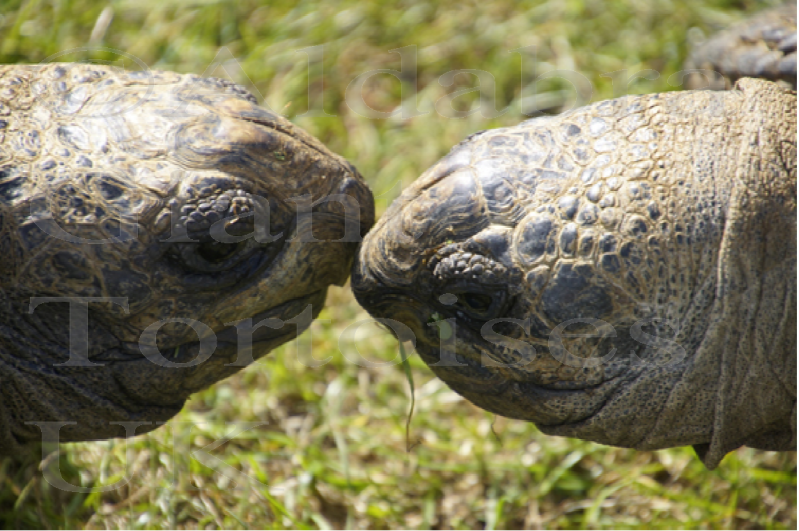
Communication between them is restricted, a large part of their body is immovable shell so visual movement communication between tortoises is not that good. Aldabras partake in a social contact called Nosing, when one animal comes close to another and lies down on the ground and gives the other animal a nose rub on its back or the neck. A ritual that can continue for quite some time. There is no clear explanation known about what it means, probably a bonding thing. There is a thought, amongst some scientists, that they emit a sound like elephants, which is out or range for the human ear to hear. Every year more research is being carried out about these animals but there is still a lot to learn. It would not be surprising if they did have a form of communication that we cannot detect.
Although they do go exploring on their own Aldabra tortoises are a herd animal and like the social interaction of being in groups. They have a strong sense of smell so they can use this to learn a lot about their fellow tortoises, particularly when they are looking for a receptive mate. Smaller breeds will also use ramming against another tortoises shell, to communicate with anther individual, whether it is to express interest in a female or to show aggression to a competing male. This is not something that Aldabras do.
Interestingly when we got our largest Aldabras they were part of a bigger group, only three of them came to us and the rest were rehomed somewhere else. Years later, we got the opportunity to take on some of these other animals and when the five of them met up again there was no animosity between them, they all settled together really easily, you got the definite impression that they recognised each, other even though they had been apart for nearly ten years.
Can They Get Bored?
YES. Just like everything else can. The saying familiarity breeds contempt comes to mind. Tortoises have such a long life and for much of the time pet tortoises are kept in captivity where they are living in the same pens or enclosures. After you have wandered around it for a few years and explored all corners and found nothing new of interest, then you are bound to become bored with your surroundings and do not feel the need to explore more. That is why it is good to change things around every now and then. Nothing major, you do not need to build them a new pen every year, but you could add or move things every so often. Maybe include different scented plants or levels of terrain. Allow grass to grow longer than normal, if you have to cut it, so that it creates natural sight barriers and they have to walk around to see what is at the other side.
Spread the food treats around so that they have to sniff and search for them and walk around. Maybe alter the way you feed them occasionally by giving them browse, so they have to stretch to reach it, providing them with exercise. Give them different types of treats so they have to thin how they will tackle eating it. Eating a carrot that can roll around is different to just grazing on grass that they can grab by the mouthful.
Add different textures like stones or slabs to their environment, to help keep their feet healthy. Move their water bowls around, make them look for it as they would in the wild.
Spend time interacting with your pet, that is part of the reason you have one after all, and vary the time of your visits with them, so that they will take an interest in your presence and it does not just become routine.
Think of how you felt during Covid Lockdown when everyone was kept indoors with reduced contact and lack of things to do. Many people suffered with mental health stress from being kept confined and isolated. Your tortoise could feel the same. Do not keep them cooped up inside just because it is easier for you. Your Aldabra not wanting to come back in at bed time, just because you say they should, is one of the frustrating and inconvenient hazards of owning such an animal. They have a right to be outside exploring and if you cannot cope with that in your life schedule then an Aldabra may not be the right pet for you. Satisfying your pets mental health requirements is just as important, for a responsible tortoise owner, as it is to satisfy they physical health from the correct husbandry regime. It is beneficial for them to go outside and experience the sights, smells and sounds of nature and it is down to you to make that possible for them.
Is Stimulation Important?
Again, yes. You like to have things to keep yourself occupied and interested, the tortoises are the same. Put new plants in large secure pots in there enclosure, to offer different shade and stimulation but make sure they are high enough they cannot be completely cropped or knocked over. If they are in pots you can take the back out again, or move them around and this once again easily changes their environment.
Put some low walls or obstacles into break up the line of sight, if they can not see all corners of the pen from where they are sitting it will make them curious and they can go off and explore. It will also give them the illusion that they can get away from the other tortoises they live with and have time to themselves. If they cannot see their other house mates it will make the think that the pen is bigger than it actually is. Make sure that you use size appropriate items though.
Spend time with your tortoise and interact with it. Stroke it, tickle it, make it Finch. Give it a wash or a scrub, something different breaks up the hours of the day and gives them something else to think about.
Give them different foods as treats, different smells and textures, get them using different senses, not just sight. Suspend browse so that they have to stretch and reach to get it. Using different muscles and thoughts on how they are going to get it etc, all of this extra stimulation enriches their life.
In the wild they would have the chance to go wandering off to the other end of the island if they wanted but in captivity they have a very limited amount of space so we have to try and keep it as interesting as possible. We are not saying you have to redesign the pen every day, that could just make them feel stressed. But try to do something with them at least once a week, even if it is just move their water bowl to a different area of the pen. The whole point of your pet is that you spend time together, enjoying each others company, otherwise you might as well get a stuffed toy tortoise to just sit there neat and tidy.
Tortoises may not be able to come rushing over and give you a hug or a lick but they will come towards you when you enter their pen. They will perk up and show renewed interest in their surroundings when they see you approach, wondering what you have for them, either a treat, a tickle or a procedure like scrubbing their shell.
If they are indoors maybe put the radio on as background noise for a short while. We are not suggesting that you blast hard rock or techno music at them for 15 hours a day but hearing different voices talking or singing will stop them from sleeping and give them something else to think about. You could even join in with your favourite song, as you clean the pen out, the are hardly going to critique you if you cannot hold a tune!
Can Aldabra Tortoise Really Sleep 18 Hours A Day?
Yes, in the wild when the weather is too hot they can sleep away the hours conserving energy until it cools down and they can go out of their shade and get back to foraging for food.
In captivity, in the UK and Europe, they have no need to be sleeping for so long, that is just depression and not living. If they are sleeping for that long then you have a husbandry issue that needs sorting, as they are bored and need something to stimulate them.
In high summer the weather might be too warm for them to want to move around as much but in spring and autumn they should be active for most of the day. Ours can get up at 7am and still be out and about eating at 9pm, on a nice day.
If your tortoise is indoors, and not moving much, then turn the heating down a little or give it fan to circulate the air and cool them down slightly. Aldabra can be a windy place in the wild, so it would not be unnatural for them. Improve your husbandry and give them something to do, make them use their brain. Maybe change the way you feed them, use a feed ball rather than just putting a tray down for them to eat off. Cut it up into smaller pieces of food so that they have to spend longer struggling to pick it up rather than getting a large mouthful in one go. Put the food, water, and heat source in different areas, and not all together, so that they have to get up and actually move if they want something. Having waiter service is not good for their muscles and can lead to them overeating.
Vary the times that you go and interact with them or how you interact with them, on a daily basis. If it is too cold for them to go outside to graze, maybe change around the times that you feed them or something, possibly smaller portions more often rather than one big feed a day. Small changes can inspire interest and curiosity as well as build the bond between yourself and your tortoise. Things to enrich their lives does not have to cost a lot but can make a bog difference to the quality of their life.
Don't Accept You Tube Tortoise Videos As Gospel.
You tube videos are very interesting to watch. But you need to remember that many of these videos are not produced in the UK. The Americans, and Aldabra keepers in other parts of the world, have some stunning animals. There are many videos on Aldabra and Sulcata tortoises, from people, on the internet, uploaded to places like YouTube etc. However, just because you see them doing something on their video does not mean that it would be right for your animal here in the UK. They have different weather, foods and attitudes to their tortoises care. Someone in America or Asia is going to have different methods of looking after their animal, and problems to combat, that will not work in our climate in the UK. Not casting aspersions but some owners also have some weird ideas about how to care for their Tortoises and these should definitely be taken with a pinch of salt and not just blindly followed because someone on a video said this is the best environment for your tortoise.
Appreciate their posts for what they are, but do your own research for what your tortoise needs in this country. A tortoise left to free roam on a huge Texas ranch is not the same as free roaming around a housing estate in Colchester.
On many occasions their tortoises are just left to do their own thing because their weather conditions, in some places, are much more like Aldabra and Africa. The UK is different, we have to recreate those conditions artificially so we need to monitor their care more closely.
When Were Tortoises First Brought To This Country?
Tortoises, in general, were first brought to the UK by the Romans, who kept them as pets, not as a food source. Later, from the Seventeen Hundreds it became a popular exotic pet for wealthy landowners to have them, particularly, the larger species, roaming on their estates. Giant tortoises have been a source of fascination for many people since they were first discovered. They were first kept in captivity in the Seychelles in 1769 and Berlin zoo have had them on show since 1845.
In the 1960’s and 70’s the pet trade in tortoises took off and you could get them from a number of unusual places, besides buying one at a pet shop. Unfortunately for the tortoises they became the new "it" fad but sadly no one really knew how to look after them properly. Cat food was often recommended which is a big no no as most tortoises are vegetarian. However, if you are hungry enough you will eat anything, so they often died from a very poor and unsuitable diet.
The other unfortunate consequence of having them as a pet was that they would often escape and go wandering off into neighbours garden, many were not recovered and a few may even have managed to live wild. This inspired the practice of drilling a tether hole into their shell, usually in one of the scutes near their back legs, so that a rope or chain could be attached to it and the tortoise could not wander from the garden. This does sound a rather barbaric procedure, as the shell has nerve endings and blood vessels in it. In practice it would probably be rather like having your ears pierced, it hurts briefly when it is done but then will give you no further pain. This practice is no longer encouraged, and not usually necessary since most gardens are now much better fenced off than they were in the past.
The good news is that we hear numerous stories from people who have found them wandering and taken them in as a family pet, when their owners did not reclaim them for whatever reason, and they have lived long happy lives, to be handed down through the generations as a living family heirloom. There are a surprising number of households who currently have, or have had, a tortoise in their lives at some point.
Between 1969 and 1972 it is thought that an estimated 480,000 Spur-thighed tortoises were imported into the UK. These crates and crates of animals did not have the best trip over from south east Europe and many died enroute leaving decimated numbers in their home region.
Once they arrived here, life did not immediately get better for them, as it is believed that only 1 out of every hundred Spur -thighs survived their first winter. Thankfully, greater efforts have been made to improve their care, over the years, and many of the fortunate survivors have lead a long and happy life in the UK.
It is as a result of these import practices that the CITES legislation was set up, coming into force 1 July 1975, after years of planning between the countries involved. Cites protected tortoises can no longer be taken directly from the wild, for the pet trade, and they need an A10 certificate to be bought and sold.
There are an estimated 400,000 tortoises and turtles living in the UK, which are kept as pets. Of these around 0.05% are Aldabra Giant Tortoises.
What Was The Largest Shelled Animal Found In The UK?
The largest wild animal, belonging to the tortoise family, that was found on British soil was the carcass of a Leatherback Turtle, which was 9 ft 5 inches (around 3m) long, it was found washed up on the beach in Harlech in Gwynedd, North Wales in September 1988. It was thought to be around 100 years old at the time but unfortunately, it had drowned after becoming entangled and trapped in fishing lines. The turtle is now on display at the National Museum in Cardiff.
Death By Tortoise
In 456 BC the Greek dramatist, and successful playwright, Aeschylus was supposed to have been killed by a tortoise, which had been dropped, by an eagle, onto his head, whilst he was visiting the city of Gela. It is most likely that it would have been an Egyptian Tortoise, which are small enough to be picked up by a bird of prey, which have learned to drop them from a great height, to open them and allow the bird access to the meat inside. Unfortunately, Aeschylus seems to have either got in the way of its landing on the ground or the eagle mistook his bald head for a rock, and dropped it on him in an effort to cause the tortoises shell to break. His death is the only documented case directly attributed to a tortoise
Are Tortoise Shell Products Really Made Of Tortoise Shell?
Originally they were. However, in actual fact most of the original tortoiseshell came from the Hawksbill Turtle, which was found in the Pacific Ocean, and as a result it became a highly endangered species. The outer shell was stripped, by heat, from the turtle, sometimes whilst it is still alive. A few survived to grow a second shell to compensate but they would have endured a lot of pain. World wide trade, under CITES, was banned in 1973. Thankfully, modern tortoise shell is made of plastic or other synthetics of some form.
Gross But Interesting
In the 17th century, there was an Italian, scientific, gentleman called Francesco Redi, who was known as the founder of experimental biology. He performed an experiment that involved removing the brain of a land tortoise, which then proceeded to live for six months. Redi also cut the head off a tortoise entirely, it was still capable of walking 24 hours after decapitation and and it lived for 23 days. Not sure if that applied to the head or the body part though, whichever it is very disturbing!.
How Do You Cook A Tortoise?
Incredibly there is a book, The Art And Mystery Of Cooking, which has survived from 1665, and recently put up for auction in 2025, that tells you.
Giant tortoises were imported to this country both as exotic pets, but also by aristocrats as an unusual dish to be served at table for important guests. Not all of these animals destined for upper class dinner tables made it there though because the sailors on the sailing ships had to be fed on the long voyage home and sometimes they had eaten them all before the ship docked in its home port.
At around the time this book was published, most of these giants would have been coming from the Galapagos Islands, off the coast of South America, and not from the Aldabra Atoll where they tended to be mass plundered slightly later in history.
The book advisers that the tortoise should have its head, feet and tail cut off. It does not say if these are considered inferior cuts of meat, and to be used for lesser dishes, or if it is just a practical matter, of space, at getting such a large animal into the stew pot. The carcass should be cooked in a mixture of water, wine and salt, presumably after it has been given a good scrub first. Naturally roaming tortoises are not the cleanest of animals. Once cooked, you could pull the shell apart allowing you to pick the meat clean from the skin inside and take the Gall Bladder from the liver.
The meat should be placed in a Pipkin, which is a 3 legged earthenware stew pot, cooked on direct heat of a fire but not in the flames. The meat and liver from the animal should be stewed along with some grated nutmeg, sweet herbs that have been finely chopped and sweet butter. If the tortoise was female you could add some of the eggs to the dish as well. The stew should be served on Sippets, which is bread or toast.
To Serve, cover the meat with the upper shell, both to keep it warm and to make a more visibly impressive service, add the slices of an orange for decoration.
Alternatively the cook could make a fricassee, in a pan, where the salted meat cubes were cooked in oil or fat (probably also from the tortoise) at low temperature, so not to brown the meat. Add a whole onion or two and season with herbs such as Parsley, Thyme and Rosemary. A rich white wine sauce made with wine, sweet butter and 3 or 4 of the egg yolks, saved from a female, would accompany the meat. Again it would be garnished with more herbs and served on Snippets of warm fresh bread or toast, or alternately serve in the cleansed shell.
Inevitably the desire to try new and unusual dishes, served at the Captains Table, came back to the fashionable houses of the gentry of the time. There will always be people who can afford exotic dishes, to impress their friends and business associates, irrelevant of how sustainable the food source is.
Turtle soup was a popular favourite at formal dinners for over 300 years. Heinz stopped selling turtle soup in the 1970s when turtles became protected by the CITES legislations. You can still get Turtle soup around the world, in different cultures, and it is often classed as a delicacy, it is not always made with turtles, sometimes they use tortoises or terrapins.
Many people would be horrified at having tortoise to eat now a days, but times and customs were very different then, they were making use of food that was readily available to them and in plentiful supply at the time. Long voyages at sea where the animal, such as a giant tortoise could be kept alive, for weeks or even months, and slaughtered on demand, meant that the crew of the ship would be in much better health with fresh meat available. So it made perfect sense to have an animal on board, such as the giant tortoise, that did not need feeding or watering. They had no thought of long term effects on the species. Equally, there is no doubt future generations will be horrified at some of the food that we consider normal in our diet today.
Tortoises have played a supplementary role in the diet of humans for many hundreds of thousands of years. They would be roasted in their shell and used as preserved or canned type of food. The shells could then be used as bowls or plates.
It only became a problem when humans got greedy and the plundering began to eradicate species, contributing to many breeds of tortoise becoming completely extinct.
What Do They Taste Like?
Aldabra tortoise meat has been described as “wholesome and not unlike mutton but more delicate. The fat is white and does not congeal and is never known to cause indigestion and is considered superior to the finest butter in Europe. The liver is delicious and very large in proportion to the animal, about 1/3 of the whole weight of the flesh”.
Never having tasted it, and with no desire to do so, we could not comment but we believe most things taste like chicken.
You may want to demonise the locals for eating the tortoises, in the past, but the fact is that they are a good source of meat to feed your family. Every countries diet will be made up with what is easy for them to produce or farm. Just because we find it distasteful does not mean that it is wrong for them. It is probably very similar to the UK breeding cows and sheep, we have been doing it for many hundreds of years but other religions, and parts of the world, would find us routinely eating these animals completely abhorrent.
Can You Eat Tortoise Eggs?
Yes, they were considered quite a delicacy. Typically our sensitivities prevent us from eating them, preferring to stick with avian eggs. Tortoises eggs are mainly egg yolk and there is less proportion of white inside the shell, so that would need to be taken into account for baking but they have the same characteristics as other eggs.
When Is World Turtle Day?
World Turtle Day is the 23 May. The purpose of World Turtle Day, is to bring attention to, and increase knowledge of and respect for, turtles and tortoises, and encourage human action to help them survive and thrive.
Early Customs
In the early 1900's there was a custom in the Seychelles to mark off a young tortoise when a child was born, and to eat that tortoise on the child's wedding day.
Create Your Own Website With Webador