Please click on any of the above topics, or look in the dropdown sections for more information on Aldabra, and other tortoises.
Climate Change, Local Threats And How It Is Going To Affect The Aldabra Giant Tortoise In The Wild
Home of the Aldabra Giant Tortoise
The Aldabra Atoll is a secluded place, in the middle of the Indian Ocean, Most areas of the atoll are between 2 and 4 metres high, with a maximum height of 8m. The delicate ecosystem, is home to a thousand species of plant, birds, insects, and reptiles including Aldabra Giant Tortoises, some of the species are unique, specifically, to this island and as such it a important place of scientific interest. With a coral reef helping to protect it from easy access, by plunderers of yesteryear, being one of the main reasons why man never managed to completely wipe out this species of giant tortoise, unlike the other 9 local species, of Giant Tortoise, who were not so lucky.
Nowadays, since the 1980s, the Atoll is heavily protected by legislation and only the luckiest of scientists are even able to set foot upon its shores, with visitors kept to a bare minimum. However, in more recent years tourists are pushing against this and more people are entering these protected waters, even though the local boat captains know that it is illegal to do so, as there is a 40km exclusion zone around Aldabra Atoll, and its neighbour Assumption Island. Mans dire influence on the rest of the world is just as likely to cause these protected species irreparable harm, without even invading the island.
Although the tortoises are reptiles and they like, and need, warm weather to survive, the rate that temperatures are rising could also be what finally kills them off, for many reasons. We know that the polar ice caps are melting and causing gallons and gallons of water to be added to the worlds seas. This means sea levels are on the rise, around the islands and it will have a detrimental affect on the Atolls residents, within our lifetime.
Direct Effects Of A Rise In Sea Levels On Aldabra.
- There will be less land above the sea level, so less space for the animals to live.
- Less space puts more pressure on the food available, they will eat it more quickly and spend longer starving, which will make the tortoises be in poorer condition. If this continues long term the effects will cause a population crash.
- Poorer condition adults means poor condition babies and potentially reduced clutch sizes.
- Aldabra is a Volcanic Atoll, so, it is hard to find places they are able to dig deep enough holes to lay their eggs, so they use the beaches and dunes. However, with rising water levels the beaches will be the first to be submerged, leaving them struggling to find somewhere to safely put their eggs.
- If they do manage to lay them on the beach, there is a greater risk of them being washed away by the tide or them being covered over with water for longer, killing the hatchlings or cooling the temperature around them so they don’t even begin to grow.
- The Atoll is actually made up of 4 Islands with a large tidal lagoon in the middle. Rising water will mean this tide probably will not go out, fully, each day which will cut off the islands from each other and thus severely limiting the range that an animal can travel searching for both food and mates. If the population is separated and isolated from each other, in this way, then you will get more inbreeding, which will weaken the species or them not being able to get to potential mates and the species naturally dying out.
- A rise in sea level will mean the gaps between the four islands will widen. At the moment any tortoise washed off the beach has a good chance of remaining in the lagoon and floating safely back to shore. However the wider gaps will increase the chances of the stranded tortoise missing land and being washed further out into the ocean instead.
- Higher tides will submerge the coral reefs deeper, and allow boats easier access, so increasing the chances of poaching affecting the native wildlife.
- The lagoon is already home to Black Tipped Sharks and Rays, however, if consistently deeper water stays in the lagoon it may attract the presence of more apex predators, which will alter the balance of wildlife and could affect the sharks nursery for their pups, putting them in danger.
- Although the 2004 Tsunami, fortunately, did not have a big impact on this area. If another Tsunami developed, in that region, then they might not be so lucky next time. It could wipe out the whole island population in one go, Aldabra Atoll is only a few metres above sea level now, it would not take much to wash them all into the sea, killing most of the tortoises in the process.
- Not all islands in the Seychelles have tortoises living on them, and although there have been translocations to repopulate some more islands with Aldabra Giant Tortoise. The issue is that the majority of the species still, nearly all, live in the same, limited, area of the world, endangering their continued survival from a major natural disaster, in the region
- The current sea level rises are poised to drown substantial parts of the Atoll within the lifespan of the tortoises living on Aldabra today.
- By 2100 some scientists fear that sea levels may have risen by 8m (26.2 ft). This level of rising water would completely submerge the Aldabra Atoll, killing all life living there including reptile, bird and insect species.
- Sea levels rising in the area will affect other islands in the Seychelles too, many with similar issues to those that will affect Aldabra. Consequently the human population, native to the area, will want to or need to relocate to areas with more space. The likelihood that they will move closer to Aldabra is much more feasible, exacerbating the listed consequences.
- 38% of the 1000 animals on Aldabra are insects, and there are 100 bird species. Although some of them can fly, most of these animals are already trapped on the island because it it too far for them to fly to reach other land, unless they were lucky and were able to rest on a passing ship, part way. If the island submerges then there is no where for most of the animals, who live there, to go. There is no escape. A lot of these species are exclusive to Aldabra, and they would realistically be looking at an extinction event.
Direct Effects Of Higher Temperatures On Aldabra.
- Tortoises lay their eggs in the ground and the ground temperature incubates them to hatchlings. However, higher temperature rates will probably mean greater numbers of clutches failing to hatch. At temps over 34C, the risk of mortality or deformity in the young is significantly higher.
- Another issue with higher ground temperature will mean that the soil and sand above them dries out and becomes much harder. This 5 cm hatchling has to dig its way to the surface, once it has escaped the egg, it can take it days or even weeks to achieve this feat. If the ground is harder then they are going to struggle to get through the substrate above the eggs and may well die from exhaustion or starvation or lack of air, before they have even exposed their first toe nail to the world.
- Tortoise eggs are subject to ESD or Environmental Sex Determination. This means the temperature the eggs are incubated at has a direct effect on the sex of the hatchlings. Higher incubation temperature generally produces more girls. So, there is going to be an abundance of females and a shortage of males in the wild population. Again, over the long term, you are going to be risking inbreeding with the limited gene pool.
- Drier, hotter, weather means less rainfall. The tortoises are surrounded by sea water but they only get freshwater to drink when it rains, which is why they are forced to fast for several months of the year, already. An increase in temperature will make these wet seasons even further apart and possibly of shorter in duration. Lack of water throughout the year, for the tortoises, is going to lead to kidney and other health issues. Long term drought will cause a population crash.
- Lack of water for other species on the island will also impact their populations of rare species as well.
- Drier, hotter, weather also means the foliage on the Atoll will burn off too, leaving less food available. It will also affect the species who pollinate the foliage that the tortoise eat, meaning less pollination causing a shortage of food.
- Dry foliage is also an increased fire risk, which could quickly spread and kill all the residents of the Atoll, as there is no where to escape to. The closest neighbouring island, or land, is Assumption Island 28 miles away.
- The lack of foliage, natural shrubs and bushes to shelter beneath will also cause the tortoises to overheat. Yes, they are a reptile and need the sun to heat them up to temperature, but they also need the shade to cool themselves down too, as they can not sweat and like us. Anything over 32C, for long periods, can be too much for them. Overheating is a major cause of death in wild Aldabra Tortoises.
- Lack of foliage will mean less shade for plants to grow out of the hard heat of the sun and the already thin and poorly nutriented ground soil will be more exposed to erroison, so less plants will grow in it. All meaning less food for the animals including the tortoise.
- Natural evolution will ensure only the strongest survive, so the numbers in the wild population will begin to fall, and again, this is going to limit the gene pool that they have available and so increase the chance of deformities or other health issues, including the inability to breed in the future, developing amongst the group.
Increased Wind Speeds Effect On Aldabra Atoll
- More frequent Cyclones, in the area, will knock trees down, potentially killing tortoises in the process but also less trees means less shade available.
- Higher winds produce turbulent seas and a greater risk of tortoises being washed off the island and out into open water, to drown, starve, or succumb to a predator, in the Indian Ocean.
- More turbulent seas will also damage the coral and the eco system living in the protected waters surrounding Aldabra. Storms will also have an impact on costal erosion.
- The tortoises will spend less time eating because of the need to travel further to find shade, to prevent overheating, resulting in smaller tortoises. This is already proven as Atoll tortoises on Grand Terre are visibly smaller, partially due to there being less shade there, compared to similar aged ones on more shaded Malabar Island.
- Less trees mean less windbreaks, so, higher wind speed increases chances of lower foliage being destroyed, or not growing as thickly, or as quickly, so again, less food, and shade, available to the tortoises.
- Also erosion of exposed substrate, making it even harder for things to grow in the future. Soil is already thin and poor, it has been subsidised with nutrients from the tortoises copious amounts of poo, over many generations.
- Less trees and foliage will affect other species on the islands too and this will upset the fragile balance of the ecosystem there. Pollinators will not pollinate plants, so, less food, poor condition animals will have fewer offspring.
- Insects that pollinate the plants have a very short life and if they are affected by harsh conditions during that time then they will not be successful in their endeavours. If they cannot get enough food for themselves then they are not going to reproduce either. Once the pollinators have died out it will be very difficult for the plants to grow, and they will also fail. Being so far way form other land it would be very difficult for pollinators to naturally recover their numbers.
- More wind will dry out the atmosphere, less freshwater means suffering even longer dry spells between rain, than they currently endure, meaning the tortoises dramatically increase their risk of dying from dehydration.
El Nino Southern Oscillation Effect
In 1997/8 this effect destroyed 68% of the Aldabra Islands coral, at up to 10m depth, due to coral bleaching, caused by the sea temperature rising by 1.3 degrees C, above normal, for four months. The coral has slowly begun to regrow, in the intervening years, but a prolonged, or more frequent, effect could mean the coral would never recover.
The dead coral would crumble back into the sea, making less land available and also harming and altering the islands marine ecosystem, which would have an impact on the rest of the islands residents, including the tortoises.
The sharp coral reef is one of the main reasons that maritime poachers were unable to completely wipe out the tortoises from this island, in the past, as they had done to other nearby islands, because the coral made landing a boat so difficult. The loss of this coral reef would remove that added protection and potentially increase the chances of illegal boat landings and poaching.
The Closer Encroachment Of Humans To Aldabra Atoll
- There is no Helipad or landing strip on Aldabra, so contact with the wider world comes via boat or is flown in to the small airport on Assumption Island. In more recent years the runway on Assumption, the closest neighbouring island, and only local air access to Aldabra, has been extended, at both ends, to take larger planes, thanks to Arab funding. They are also building an exclusive community for the Qatar Royal Family and their rich friends to visit.
- Larger planes means more tourists, and their disposable income.
- More tourists will bring more income to the area for the locals, which is not a bad thing. However, it will have the knock on effect that they will also have more income to spend on leisure too. So it is bound to affect the area around Aldabra, as leisure facilities in the Seychelles region expand.
- More smaller private lanes, overflying the island, as tourists want a chance to see it from the air. Making more air pollution.
- More noise disturbance.
- More support services required.
- More accommodation being built,
- More human encroachment and less consideration for the continued survival of the native environment by things such as illegal fishing.
- More rich people thinking they are entitled to do what they want, and go where they want, if they pay enough. Or influencers looking for the next like.
- More government decisions prioritising money coming into the region from tourists, rather than the needs of the local wildlife.
- More people wanting to dive in the sea and increased presence threatens damage to the coral reef.
- More human disturbance results in more rubbish and non recyclable waste, and direct impact on the local area in general, as well as the animals that live there.
- More human activity in the area will mean even more plastic pollution in the seas and on the beaches. In 2023 it was calculated that 513 tons of plastic was polluting Aldabra. The sandy beaches get covered with it, when it washes ashore, with the tide, and the Green Sea Turtles have to clamber over it, like an obstacle course when they come ashore to lay their eggs.
- More tourism and development in the area will also have a big impact on Green Sea Turtles who nest on the beaches of Aldabra and Assumption. They have been a successful recovery story over the last 50 years but this progress will be in real jeopardy because of more human intrusion to their breeding grounds. More chances of them being caught in fishing nets and the detritus dumped n the sea.
- More human presence means a greater threat of a bio hazard, or a non native plant or animal species invasion to Aldabra Atoll however unintentional, which could potentially decimate the fragile and unique ecology.
- Tortoises risk becoming more used to people and no longer behave as naturally, Aldabra Atoll is one of the most ecologically pristine places left on earth and mans closer intrusion to their borders will no doubt threaten this.
- If the animals on Aldabra are overly influenced by the human environment it could potentially void study data. Some of the studies have been going on for a 100 years, or more.
- More people in the area means more fuel powered boats, both leisure and supply, to pollute the local waters and severely increases the risk of island poaching to all of the unique wildlife, not just tortoises.
- Unfortunately Aldabra is located near to one of the busiest shipping routes on the planet, it would be ever so easy for there to be an oil spill and cause a cataclysmic contamination to the whole area, and potentially wiping out a delicate ecosystem.
- A potential oil terminal at Astove Island would put Aldabra in the direct path of any oil spills, or seepage, due to local currents, risking a catastrophic outcome.
- In the last 20 years or so, an emphasis on development in the Seychelles has led to a lack of support and long term security for tortoise projects. Conservation is now more reliant on privately owned islands, which can have funding issues.
Aldabras closest neighbouring island, Assumption, was one of the last undeveloped islands in the region. However, a Qatar based investment company called the Assets Group now has a land lease agreement worth $25 million USD with the Seychelles Government to develop the island, against public concerns. They are currently building 40 high end villas, in the islands sand dunes, to become a luxury resort for the Qatari Royal Family and other affluent Middle Eastern tourists.
There is one hope for the region, and that is that these people will respect the value of this isolation and use their wealth for the good of the local wildlife and restrict access, and human impact, to protect the uniqueness of the area and not just turn it into a rich mans playground because they have nothing better to spend their fortunes on. They would have the funds and influence to make a real difference for good, and ensure that this important and last evolution outpost survives, in its purest form, for future generations.
The presence of these super rich, seasonal, residents may have the detrimental effect of attracting more piracy to the area. This has already become more of a serious problem, and threat, over the last decade or so. However, given that these people, such as the Qatar Royal Family, are more than likely to travel with their own private security, their presence on Assumption Island could in fact be an unconscious benefit for the protection of Aldabra Atoll and the local area.
They have every right to spend their money how they wish, and for a country that includes a lot of dessert areas, it must be idyllic to have a beach house on the edge of the Indian Ocean. The Seychelles is an area that relies heavily on the tourism industry, and after the local hardships of the Covid 19 worldwide lockdown, $25 Million USD will probably buy you a lot, and allow you to get away with even more, unchallenged. However, they need to remember that this untouched isolation is probably one of the strongest attractions to them wanting to develop and occupy the area, in the first place. It is therefore their social responsibility to ensure that this cherished idyll is not lost beneath tacky, modern, mass, tourism attractions, before it is too late, because once the area has been altered it can never be returned to its former pristine ecology. You cannot stop change but are they prepared to do good with their money, and work with nature, for the benefit of both man and animals, rather than against it, and risk its loss forever, for the sake of a quick Dollar, or brief, adrenalin gratification, enjoyment by over indulged tourists?
The Arabs were the first to discover the Aldabra Atoll, naming it Al-Khadra, the Green Island in 916 AD, so must have some vague sentimental attachment to it, and it would be poetic if they were the ones to ensure its continued, future, survival 1110 years later.
History and science has shown that over the millennia these islands have been severely affected by weather, and wildlife populations have been decimated, it has happened in the past and there is no doubt it will happen again, sometime in the future too. Man has caused many of these problems, for this peaceful animal, or at least accelerated the situation, and it will be down to man (and woman!) to help save them, or at least try to rebalance things.
It is unlikely that just one of these climate issues will change the area, beyond hope. It is more than probable that it will be a combination of threats that will make the Aldabra Giant Tortoise into an endangered species, or even worse an extinct species. The projected overall decline of Aldabra Giant tortoises in the area, in the next 100 years, from climate change is a potential loss of 40-60% of tortoise population.
There are breeding populations in the USA and they are a popular pet around the world. But no one in the UK has successfully hatched Aldabra eggs, for many different reasons, and it has only very recently been achieved in Europe, and Taiwan. So, there is a long way to go before we could help repopulate a species. No one outside of the Indian Ocean region has achieved second generation breeding of the Aldabra Giant Tortoise.
Over the past few decades there have been a number of cases where Aldabra Giant Tortoises have been used to re wild neighbouring islands, to differing degrees of success. This is good because it does not leave all of their population in one small space but distributed around the region. The major problem with this though, is that the other islands in the Seychelles will be in very similar situations, with the threat of rising tides and temperatures, so the tortoises continued presence is not guaranteed despite the well intentions of these projects.
The wild population of Aldabra tortoises numbers around the 150,000 mark and at the moment it is able to self sustain itself. They have not really evolved in their design since prehistoric times, if it works for them why change it seems to be their policy, unfortunately this means they are not going to change quickly enough to combat the accelerating effects of climate change.
Due to their home island being so isolated, this is a virtually closed population of Aldabra Tortoises. Scientists have found that analysis of Aldabra Tortoises Mitochondrial DNA (that is DNA passed down through the female side) from several locations, on two of the major islands, shows no variations in sequences. This indicates the population was started from a founding event, which means almost all of them descend from one gravid female who first arrived on the island, when the sea levels last dropped, to reveal land, and there have been few, if any, further tortoise landings to diversify the genetics of the tortoises living there.
From that one female, the population, of her descendants, has expanded to over 100k animals but as the tortoise numbers on Aldabra are forced to shrink due to climate change, it will be a case of survival of the fittest but it will also intensify the problems of in breeding, as the genetics become even more limited. This could either create natural extinction, if they can no longer successfully produce viable young, or a lot more health issues or deformities, in the wild population, if we do not intervene in some way.
Or, given that they have been inbreeding from the beginning without dire consequences, to date, it could be a case of evolution in the making, as they are forced to evolve, in order to adapt to their new surroundings. Over the next thousands of years, there may even be a resurgence of their dormant ancient turtle DNA so that they can evolve to go back into the sea and escape the issues of limited land to live on. It will be interesting to see where nature takes them (not that we will be around to know!).
Plastic pollution
The Seychelles is a region that relies heavily on tourism for its income, and Aldabra Giant Tortoises are one of their major attractions, so of course they are going to want to share their best images possible, with the public, to attract visitors to the area. Places like the Seychelles archipelagos conjure up images of perfect idylls. All of the pictures you see on the internet show a beautiful, clear, turquoise lagoon, with green vegetation around it. Picture taken from the air show Fluffy white clouds floating over clean, clear, sand and all bathed in lovely warm sunshine. A quiet, perfect, picture of paradise, to inspire anyone to want to get away from it all and go and visit for a while.
The reality is different, Aldabra, and its inhabitants are at severe risk of what humans are doing to the planet. Probably one of the more important and severe, issues that is affecting them, right now, more than the usual climate change of sea rising and temperature increases, is plastic pollution.
Pollution clutter is creeping further and further inland, gradually covering the pristine coral white sand with washed up rubbish. Pictures always show the idyll but pollution is becoming a major threat to the species who live on Aldabra. Especially the Green Sea Turtle who come ashore specifically to lay their eggs on those beaches and have to clamber over an obstacle course of rubbish to even get there. Their population have done so well to recover, in numbers, over recent years but their success story is in jeopardy because their nesting areas are becoming swamped with plastic rubbish. Other animals risk eating it or being poisoned from contents, or becoming stuck in it, this problem is potentially affecting the whole range of species on the Atoll.
The Leatherback Turtle is most at risk from plastic pollution because it eats jellyfish and more plastic floating in the oceans could easily be mistaken for jellyfish., resulting in the turtle eating it.
Aldabra Atoll is surrounded by open sea, for nearly as far as you can see, it is nearly 30 miles to its closest neighbouring island, Assumption, which is currently sparsely populated. The tortoises are 285 miles from Madagascar and 427 miles from Tanzania on the East coast of Africa. And there are no more than 25 scientists, researchers and support staff living on there at any one time, so it is hardly a bustling metropolis.
However, in 2023 an estimated 513 tons of plastic was polluting Aldabra. One researcher working there, noted that in 10 kilometres alone, on the South Western edge of Grand Terre there were 1700 plastic buoys, which are used on board ships, and other marine endeavours, too prevent collisions, that had been stranded on the shore.
This plastic comes in all forms, from the ships buoys, or plastic bottles both large and small, to more personal items like flip flops. 19% of the waste collected from the shore line were just flip flops or sandals, that is not just the odd one or two, there were literally thousands of them littering the beaches. although clean ups are carried out, in the area it is an ongoing problem that is getting worse with every year. Almost as soon as one lot has been cleared away, the sea replaces it with another load.
Most of the rubbish is coming from Asia, where a lot of plastic rubbish, from the rest of the world, is taken to be processed, as well as the areas increasing tourist industry.
When the new exclusive resort which is being built on nearby Assumption is completed there will be more people living closer to Aldabra and more rubbish will be generated as a result, threatening to make the problem worse.
Although not always deliberately dumped into the sea, nevertheless, the detritus that does end up there floats on the surface of the water and is carried on the currants to Aldabra and then is washed ashore. Netting and restraints from the fishing industry, both local and international, are particularly dangerous as the turtles get caught up in it, when they come to the surface to breathe and it can kill them, either tightening around limbs and neck or getting it caught up on something else, whilst they are swimming with it entangled around them, causing them to drown. This is all without adding in the factor of plastic microbes that are involuntarily ingested by all of the animals in the food chain. You can find out more about this serious problem by searching UNESCO Plastic Odyssey. There are also videos of the clean up on youtube.
The tortoises may live 100, maybe 250 years but plastic can still be there in 1000 years. What plastic items that are in the seas now, may still be affecting the tortoises and the animals of Aldabra in 5 or even 10 tortoise generations time!
Most people do not realise how bad this problem is, you conscientiously put your rubbish into your recycling bin for collection and safe disposal by the council. However, your sorted rubbish is actually, often, shipped all over the world for final disposal.
We, the public, need to put more pressure on manufacturers to alter their packaging to something more sustainable. Metal cans and tins, or glass bottles and trays can be recycled time and time again but most plastic is single use and then they you can't do anything else with it. Layers of packaging could be drastically reduced, or alternately putting it in a paper bag instead, which can be recycled and growing trees is also good for the environment, in several ways.
If you are anything like us, when you look in your general waste bin, you will see that most of it is from plastic packaging, that cannot be recycled. Unfortunately, it is not something we can conscientiously use less of ourselves, you are at the whim of what the manufacturers choose to use to wrap things. Why can't fruit, veg, bread or something with a short shelf life, be wrapped in the alternative biodegradable plastic? Or, even better, paper that can be recycled, or composted. Why does every item you buy have to have its own unnecessary plastic bag, when 95% of them do not need one? It has just become habit to put everything in a separate bag and is unnecessary. It is only public pressure that is going to get the packaging industry to change. It is a world wide problem and for it to be affecting somewhere so isolated as the Aldabra Atoll it just proves how bad the situation has really become.

24 Hours That Changed The World
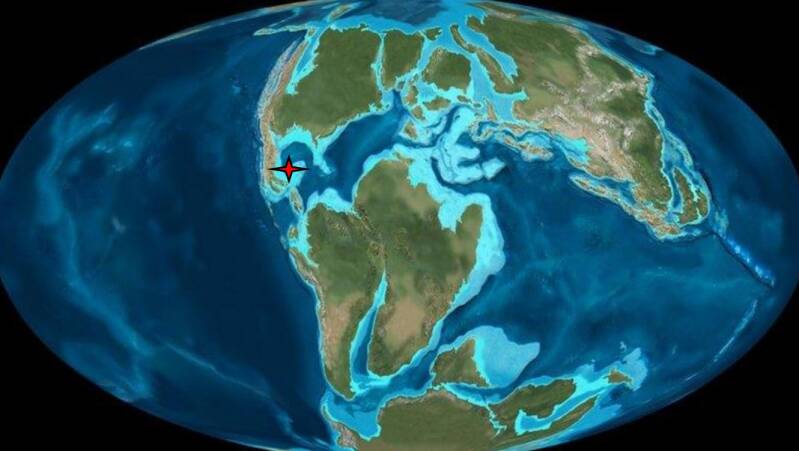
picture copyright revimage.org
Map of the world as it was 66 million years ago, showing the Chicxulub impact site, which led to the cataclysmic event that wiped out 75% of life on earth.
One late spring morning, 66 million years ago the world changed dramatically. With one single event, approximately 75% of life on earth, species large and small, being obliterated as a result of an immense asteroid impact. It was incredible to believe but by the end of that day, or shortly after, all non avian dinosaurs were extinct, thus ending the Cretaceous period when dinosaurs had been thriving in the warm and wet forests, and rivers banks but they vanished almost overnight in a hail of fire and Tsunami. The avian dinosaurs did not have an easy time either with winds of over 620 miles per hour, from the blast centre, hurling them helplessly across the flaming sky and sending them crashing into obstacles. Their only hope was to be on the outer reaches of the impact radius and there they still had to cope with debris raining down on them.
The asteroid impact site was just off the coast of what would become a tiny place known as Chicxulub, on the Yucaton Peninsular, in the Gulf of Mexico. This cataclysmic event was far more powerful than any other earthquake ever recorded. It landed with a force of 100 million megatons of TNT, which is 2 million times stronger than the most powerful man made bomb, the Tsar Bomba, detonated in 1961 at 50mt. The largest Volcanic eruption in recorded history, occurred in 1815 at Mount Tambora in Indonesia, erupting with a force of 1000 megatons of TNT and hurling 140 billion tons of magma high into the air. The following year was know as the year without summer, as Albany N.Y experienced snow in June and there was ice on the river in Pennsylvania in July. Hundreds of thousands of people died from famine worldwide.
When the asteroid hit, the world then was not the same as it is now. The continents were much closer together and wider oceans, either side of these massive land areas enabled much greater gigantic waves to form, making the worldwide devastation so much worse. The asteroid hit the sea and may have caused a wave a mile high, which is nearly 17 times the height of Big Ben and almost twice the height of the current tallest building in the world, Burj Khalifa in Dubai.
The centre of the impact was 12 miles deep, and was created by a chunk of space rock estimated to be 6. 2 miles wide, which struck earth, coming from the North East, at a steep angle, and left an impact crater of over 110 miles in diameter. Any living thing within 900 miles of the impact was instantly destroyed in the blast, which was most of the areas up to what would become Dallas Texas and Atlanta Georgia. Most of Mexico and down into Panama would have been destroyed and what would be North West Africa would have been affected by Tsunami too, as it was fastened to the North East of Brazil at the time, about where Barbados is today. The impact exploded with a force of 10, 000 gigatons of TNT or 1000 times the size of the worlds nuclear arsenal. The noise would have been intense and overwhelming, adding to the pain and confusion of the animals final moments on earth.
As it shot through earths morning sky, over a large portion of the worlds landmasses, it unleashed climate changing gasses into the atmosphere, in its wake, obliterating the sun and turning the world dark and menacing. As billions of tons of sulphur blocked the sun rays it caused a sudden catastrophic climate change, a world wide, dramatic cooling that prevented things growing. The new dawn winter, that followed, caused a temperature drop of 25 degrees, which was far too sudden for many survivors to compensate for, so quickly, and they perished.
Incredibly, the force of the collision with earth was bigger that 1 billion Hiroshima attack bombs, as 3 million tonnes of rock was vaporised and ejected across the landscape, pummelling anything in its path. A huge cloud of hot dust, ash and steam would have erupted and spread from the newly formed crater with maybe as much as 25 trillion metric tonnes of excavated material being blown up into the atmosphere by the blast that was so powerful that some debris even made it out into orbit to be dispersed throughout the solar system.
Most of this vaporised molten rock, propelled into the sky, began cooling in the upper atmosphere and became glass droplets, then gravity pulls them back to earth in their trillions, like unavoidable buck shot raining down from heaven, with enough force to easily kill and flay anything in its path. Nearly all of what is now Mexico and USA would have been devastated, causing instantaneous extinction of life, even over 1600 miles away, as they were buried in debris. Places like the areas that would become Tucson, Denver, Minneapolis, Bridgeport Connecticut and even to what would become Toronto Canada, as well as down into Columbia. If The Galapagos Islands had been risen at that time, then they would also have been wiped out by the debris.
With earthquakes all over the planet, wildfires around the globe, many of the worlds dinosaurs were already dead by end of the first day. Incredibly an adult Triceratops at 9 meters in length and 3 metres high, would be instantly slain, with their other dinosaur brethren. The impact triggered seismic events to a magnitude of 9 to 11 mw radiating right through the centre of the planet, as well as around it. An earthquake happening at the other side of the world, from the disaster site, could have caused a powerful surge of sloshing and churning water, burying everything in its path. All as a direct result of the impact, although located nowhere near to the actual collision site.
Debris reigned down from above, as Sperials of red hot molten material fall back to earth causing temperatures to rise with every second. An initial temperature surge following the collision would have been felt 90 miles away but soon the air reached the temperature of industrial oven, across most of the globe, the intense heat and the thick air making it difficult to breath and causing disorientation. The fires created by the hot falling debris caused 70% of the worlds forests to burn devastating the lives of creatures hundreds and thousands of miles away. Screams of pain and cries of anguished panic would rage through the air, along with the fire storms and there was no escaping destruction for many of the creatures, who had never seen anything like it. Subsequent earthquakes and waves reached Texas and Florida, maybe even as far as 3700 miles away from the impact site.
The centre of the crater is offshore from Chicxulub, on the Yucaton Peninsular and scientists know it is now buried a mile deep, submerged beneath 400 feet of molten rock that was to rain down that had melted in the heat of the blast when blown up before tumbling back to earth during the day following the impact. The walls of the impact crater also collapsed under this barrage and it was then be buried under an additional 70 feet of rock.
In the minutes and hours that followed, surges of water rushed back into the crater, creating a further 260 feet of melted stone on top and a Tsunami then hit, adding another layer. It was almost as if the earth itself was trying to obliterate this alien invader, burying it deep where it would never be discovered.
The giant asteroid that caused all of this chaos was actually only a fragment, broken off a bigger space rock, when two asteroids collided in space, and the smaller chunk was sent on a new trajectory directly towards earth. There is very little to see now even though the impact and resulting after effects created such world wide carnage.
The fires were later doused by devastating waves, as a ring of Tsunamis struck, their turbulent surge of water quickly entombing everything, submerging it in a sediment of mud and debris before dragging it back towards the seabed like a hungry predator.
The force of the asteroid landing, into the water of the Mexican Gulf, created Mega Tsunamis that were over 330 feet tall and possibly up to nearly an incredible mile high, at the immediate impact site, creating surge waves several meters high and flood over the top before the water is drawn back. A wave train of Tsunami followed, arriving minutes to hours after each other, rolling across the oceans, one after the other, and unleashing their enormous destructive power time and time again, battering everything in their path. To put it into perspective, the 2004 boxing day Tsunami in Indonesia had waves of 100 ft and is one of the deadliest natural disasters recorded in history.
In less than two hours, the world changed forever as mud covered everything and making food shortages for any who did make it through the initial carnage. For the initial victims death would have been quick due to forces of nature too great to withstand. For those who had survived, they now had the trauma of adapting to a new world that they were not equipped to survive in. Injuries would have been high, disease would have spread quickly, claiming more lives. Food would have been short, water sources would have been polluted, the time of the mega predators was over.
Smaller sized mammals may have had a greater chance of survival in deep burrows, in higher ground. It would give them warmth and protection and a place to store food but many would have been flooded out by the water surge. With the asteroid landing in water, the vapour thrown up into the sky cooled and mingling with the sulphur and other noxious substances it became acid rain adding further issues for the survivors. The burrows would give them better protection in the harsh conditions to come.
A large, robust, animal might have survived the surge, at the other side of the world, but wild fires start around the earthquake eruptions and in the ensuing devastation little would survive for long either on the land, in the sea, or in the air.
Following the obliteration of the sun, due to fine debris floating in the upper atmosphere, large temperature drops happened causing swift deaths of many of the smaller animals that were prey because they were unable to keep warm. As dust and soil fell from the sky, it would have covered plants and grasses with debris and poisonous substances making it both inedible and unable to grow. It would have devastated the food chain of those that had been fortunate to survive, the bigger the creature the more energy needed to live.
The dust and particle emissions most probably covered the entire surface of the Earth for several years, maybe up to a decade or more, creating a very dark and harsh living environment, with contaminated water, that would have remained that way for a long time into the future. Species would have to adapt to become resourceful omnivores, eating whatever they could, in order to make it through another day of this new hellish environment.
Practical things like the wide dispersal of animals, some ending up in territories they had never expected, due to water or wind relocation, would mean finding a mate would be harder. Many of the animals would have been in poor health due to injury, disease or malnourishment, all of this would mean repopulation would take time and inevitably a number of species would not survive into the future.
On a plus side the impact also created a vast subsurface hydro thermal system which became an oasis for the recovery of life in the seas, once things settled back down, after the turbulence of the Tsunamis displacing everything. It was a great contrast to the now much colder conditions on land. It would have been a slow process, probably over many generations for the land tortoises to fully integrate into life in the water. But in the aftermath of this changing world, turtles survived, as did crocodiles, snakes and fish species, they came to dominate the planet for over 150 million years. There were a number of very large reptilian predators in the sea, some much larger than their modern day counterparts.
Once the debris had finally cleared from the sky, and the suns rays were allowed to gradually filter through the atmosphere, life was finally allowed to take the first steps towards rejuvenation. Plants like ferns would have been the first to grow and mammals began to thrive and adapt to new burgeoning environments, developing into new species, to make the most of the new bounty available to them.
Animals, like tortoises, began to slowly reverse the process that had led them into the water, and had begun on the day the asteroid fell. Now they once more slowly evolved back to be able to live ashore, again the process would have taken many generations, it would not have happened in a couple of years.
It was 50-55 million years ago that the Testudinidae family, our tortoises ancestors, finally came ashore on a permanent basis and once more developed fully into land tortoises, reclaiming the continents and slowly evolving into the myriad of tortoise species we have one earth today, each designed to fill a niche in their eco system. This also included the now long extinct Megalochelys Atlas, who stood 2m tall and is considered the biggest land tortoise on record.
They did not have an easy time though, there were many more environmental threats, to their very existence, over the years. For example: between 930,000 to 900,000 years ago there was a severe cooling period, around the world, which led to glaciers covering much of the land and a drop in surface temperatures, so nothing grew. Despite the glaciers being full of water there was a drought of liquid water, which led to a lack of food for everyone. This period, known as the Middle Pleistocene lasted for over 100,000 years. Over 98% of human ancestors were lost at this time and the human population dropped to just 1280 breeding individuals. (I don’t know how science worked out that exact figure). If it was so bad for humans then there must have been equal devastation for the wildlife of earth, including the tortoises.
History proves that climate change happens and it has happened numerous times over the previous millennia, eliminating life by fire, flood, ice and heat. However, nature is resilient, it evolves, adapts and overcomes, some of it will always survive, just not all of it and maybe that time has come for humans.
As enterprising humans we many be able to slow the process, that our advanced presence no doubt helped to escalate, but we also need to accept that mother nature is the planets ultimate ruler. It is obvious it is going to happen again sometime, we can only do all that we can to delay the inevitable.
A MODERN THREAT
ASTEROID 2024 YR4
At the end of 2024, an Asteroid named Asteroid 2024 Yr4, was in the news. It was first noticed 2 days after Christmas, that year, from a telescope in Chile, when the asteroid came close to Earth, at just 500,000 miles, which is about twice the distance from Earth to the moon.
Apparently, asteroids of this size hit nearly every few thousand years and, alarmingly, this one is calculated to strike Earth on the 22 December 2032. The reason why this information has been included on the Aldabra Giant Tortoises website is because currently the target corridor for its possible landing is between Northern South America and across the Atlantic ocean to Africa. This will potentially also threaten countries such as India, Pakistan, Bangladesh, Ethiopia, Sudan, Nigeria, Venezuela, Colombia and Ecuador.
If it impacts to the eastern side of Africa, or towards India, it could have very real consequences for the Aldabra tortoises, on their home Atoll, and the other islands housing them in the Seychelles. A Tsunami could cause devastation to both tortoise and human populations.
Similarly, if the impact is near the equator in South America then the Galapagos Giant Tortoises would be endangered both from the impact and a possible resulting Tsunami, or even further earth quakes around the area.
The space rock is travelling at 10.6 miles per second, which is 38,028 miles per hour and it is 60 metres across in size. According to scientists, the regions at the end of the corridor will most likely receive a glancing blow, most of the energy will affect the impact location, which cannot be pinpointed at the moment. Originally the odds of it colliding with earth, were 83 to 1, but those odds shortened to 43-1, and then 32-1, that it will impact on earth somewhere.
It is currently estimated that the blast would be similar to the Tunguska Asteroid, which detonated in an air burst explosion on 30 June 1908 near the Podkamennaya Tunguska River in Russian Siberia. Luckily, it landed in an unpopulated area but it still flattened 830 square miles of trees, that’s about 80 million trees, and caused significant forest fires. It is the largest impact event in mans recorded history, even though scientists have worked out that there must have been worse impacts in the worlds history, such as the one that struck Chicxulub in the Yucatan Peninsula of Mexico, 66 million years ago, and wiped out the dinosaurs.
The projected energy released from the impact of Yr4 2024, would be the equivalent of 8 megatons of TNT, and the power of it hitting would be equal to 500 times that of the Hiroshima bomb of WW2. It would be travelling 38,000mph, at the time, and the rock asteroid is about the size of a football pitch. So, it has become more threatening, enough to require scientists to create an international response team to decide what to do about it. They are looking at ways to deflect it out of the impact orbit, but if they don’t get it right then it could just impact somewhere else, causing more problems.
A blast this size could topple residential buildings up to 12 miles from the epicentre, but the explosion could produce damage as far away as 31 miles wide from impact site. Aldabra is only 21 miles long and 8.1 miles wide and only 8 metres high, at its maximum, which is about the height of a 3 storey building. So, there would be a strong possibility that most of the island could be obliterated. even if it wasn’t, the animals would not be able to escape. Damage to their landscape would cause them to be poisoned from contaminated water, starved from vegetation damage, not to mention any physical injuries or trauma that might have incurred to them. Realistically, help would not be imminent, as the local human population would be the primary target for assistance and rescue.
Yr4 2024 was the riskiest asteroid ever detected by humans. Thankfully, by the end of February 2025, the odds of impact altered, drastically, so that there was a 99.9961% chance it will pass without incident. However, there was then a 0.8 % that it could strike the moon instead of earth, which would also have implications for earth’s timing of natural events, tides and light, as they are affected by moon.
So, realistically, we do not need to indulge in scaremongering or hoarding bottled water and tinned pineapples, just now. However if that 0.0039% chance does come to fruition it could have serious and catastrophic inferences for all of the giant tortoises in the wild, not to mention the surrounding human population and other wildlife.
If it did head our way, it would most likely explode in the atmosphere of earth before crashing into the surface, to wipe out an area the size of within the M25. Unfortunately, it can only be viewed until May 2025 and then the next sighting wont be until 2028. Currently scientists are looking at data from 2016 when it is last thought that it came close, to try and get some information on what it might do next.
As of end of Feb 2025, they are saying it is no longer a threat to impact, but who knows what will happen to it whilst it is out of sight, over the intervening years. In September 2027 NASA is planning to launch a space telescope to track asteroid, using infrared to spot them before they become a threat.
Whilst it is clear that Earth is not immune to asteroids impacting and the next one could arrive with little warning, forever changing life on earth, there is not a whole lot that we, the little men and women can do about it, so, we should just get on with current life the best that we can.
Joke!
Q: Where do turtles go when there’s a hurricane?
A: A shell-ter.
Create Your Own Website With Webador